
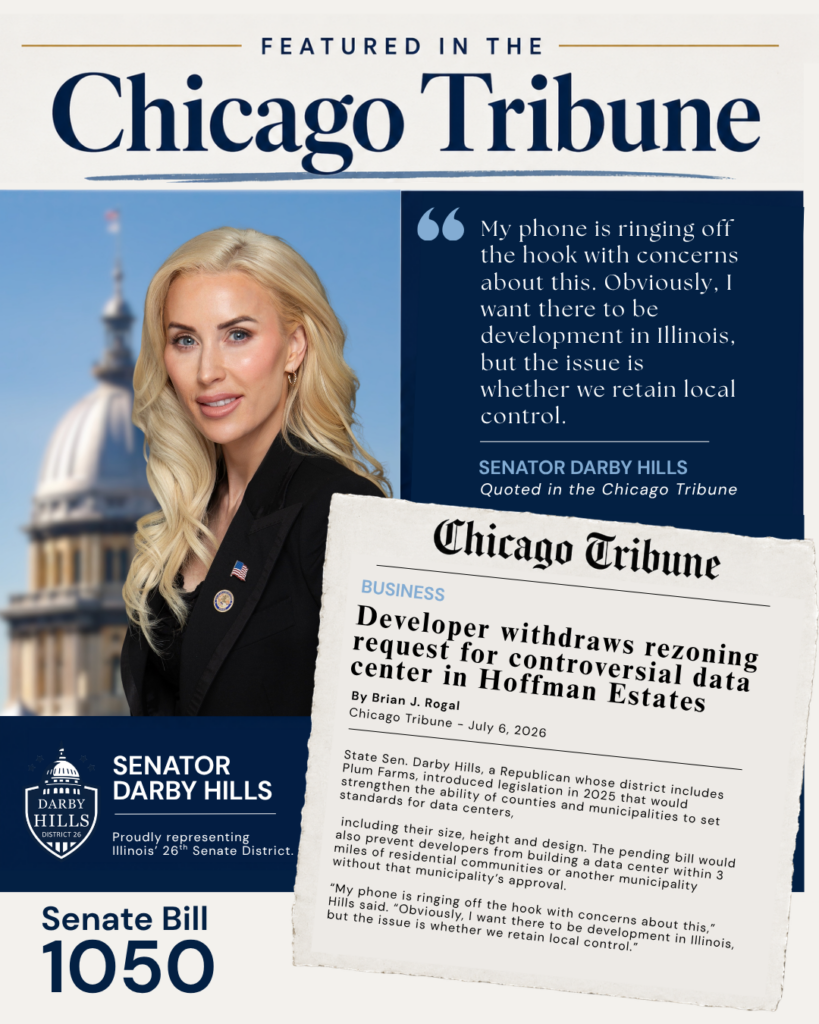
State Senator Darby Hills was recently featured in the Chicago Tribune following the withdrawal of the proposed data center rezoning request in Hoffman Estates, an issue that generated significant public engagement throughout the region.
The decision to withdraw the proposal came after residents, neighboring communities, and local leaders raised concerns about transparency, public input, and the potential long-term impacts of the development. Senator Hills said the outcome demonstrates the importance of community involvement in the decision-making process.
“When residents come together and make their voices heard, meaningful change can happen,” Hills said. “This decision reflects the importance of transparency and ensuring local communities have a voice in developments that could affect them for generations.”
Throughout the discussion, residents also highlighted a broader concern: neighboring municipalities often have little or no opportunity to weigh in on large-scale developments proposed just outside their borders.
In response, Senator Hills introduced Senate Bill 1050, legislation designed to strengthen public notice requirements and require written consent from neighboring municipalities before a data center could be constructed within three miles of their boundaries. The proposal seeks to provide greater transparency and ensure surrounding communities have a meaningful role in the planning process.
“Responsible development and community input should go hand in hand,” Hills said. “Families deserve transparency, meaningful public engagement, and a seat at the table before decisions of this magnitude are made.”
Although the Hoffman Estates proposal has been withdrawn, Senator Hills said she remains committed to advancing policies that protect local communities while supporting responsible economic development throughout Illinois.
Read the full story on the Chicago Tribune.